

11·
12 days agoThat’s remarkable considering Linux is only 33 years old.

That’s remarkable considering Linux is only 33 years old.
thats a lot of words for contributing for a single year, only half of which was ‘volunteer’
How long have you been contributing?
Two comments about this:
It is my firm belief that 99% of the population of any country ruled by a dictator are the primary victims of that dictator, don’t condone what their rulers do, have done nothing wrong and are just trying to be good people in unfavorable circumstances.
The Russians are no different and it isn’t fair to impose on Russian individuals of obvious good will the treatment governments apply to the Russian government, because the Russian government and the Russian people are two very different things.
Linus said in this interview:
I’m Finnish. Did you think I’d be supporting Russian aggression?
and here I’m telling you this: Linus acts like a dipshit.
I know the Finns very, VERY well, and while they’re generally great people, when it comes to Russia and Russians, they have epidermic reactions of totally unreasonable proportions.
I understand where they’re coming from and why they react like that, but Russia is to the Finnish people what peanuts are to someone with a peanut allergy: the reaction is totally disproportionate and with zero nuances.
Don’t ever try to argue with a Finn that a Russian person can be good, and that Putin is also their enemy: the Finn will shut down and stop talking to you - meaning, in their culture, that you can politely go fuck yourself.
And that’s what we’re witnessing here with Linus: however many years he’s lived in California, he still hasn’t shed that part of his upbringing, and quite frankly, shame on him.
I use i3 - Sway is supposed to be 100% compatible with i3 - and I find the configuration file very straightforward. What’s different in the version in NixOS?
Well if you say so, I defer to your higher authority on bullshit.
Not cheers, no. But it increased my problem-solving reputation within the company and it made Linux more appealing to key people in the company.
What’s wrong with that? What’s your butthurt? Are you bitter about something?
Well I’m sure they have very good reason and I’m not questioning them. I’m just talking from a user’s standpoint (and I’m a very poor Windows users): whenever I try to port any of our tools to Windows, wham the damn antivirus kicks in and puts my stuff in quarantine. If I use an engineering application that talks to some device on an unusual port - and I’m talking outgoing traffic, not incoming, wham it’s blocked. And unblocking it requires making a formal request to IT, that whitelists the application, until WithSecure updates itself and forgets about it, and here we go again.
It’s just a complete PITA. You constantly feel like you’re fighting an algorithm with stupidity built in just to get normal, honest-to-goodness work done.
It’s whatever works for you.
Me, depending on the type of file, I either have a more or less full description (so I can find things with find and English words) and/or some sort of short coding system that makes sense for a given type of file. After using the same codes for a long time, I know exactly what they mean.
For example, I would name an ebook “823-sf-rah-The_moon_is_a_harsh_mistress.epub”: that way I can look it up by DDC number (823), genre (SF), author if they’re well known (Robert A. Heinlein) and of course the title of the book, or any combination thereof. That’s my own system for ebooks.
For music, I make one directory per album or record named artist-comma-name (e.g. “Al_Di_Meola,Orange_and_Blue”) and the individual tracks inside as e.g. “track01-Paradisio.mp3”, “track02-Chilean_Pipe_Song.mp3”… The reason I only do one directory deep per album instead of, say, author/album/tracks is because most MP3 players back in the days, and most music apps today, understand that way of organizing music. That’s my own system for music.
Etc etc. Just make up your own system that works for you. Just stick to characters that are acceptable in all OSes’ filesystems so you can move your stuff around without problems, and avoid spaces so it’s not a pain to type.
mv?
Honestly, just prefix or suffix the filename. I’ve been cataloging all my stuff like that for the past 30 years - including, for things like music, the track number, which the filesystem and every portable device under the sun will naturally sort and play in the correct order. Finding things can be done with regular filesystem tools like, well, find. And it will work exactly the same way in all OSes that have a concept of filesystem.
Funny you should ask: I installed Debian 32-bit on an old Asus Eee PC netbook yesterday to breathe new life into that old machine and turn it into a controller for a piece of test equipment we have at work. My company keeps old stuff like that around until space is needed in case someone needs something.
Just in case I had to modify something in the tester’s control software, I figured I’d install i3wm and Vim. It didn’t take long and I was surprised by how usable the machine ended up being. Honestly I wouldn’t have minded using it as a bone fide laptop for light-duty work on the go.
So basically keep your expectations low and install super-lightweight software, and your old Aspire could live a few extra productive years instead of going to the landfill.
deleted by creator
deleted by creator
I’m a kid of the cold war.
It’s behind a firewall. The only thing exposed to the outside is port 22 - and only pubkey login too.
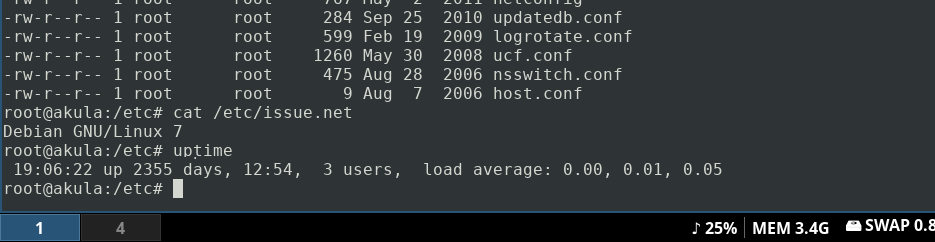
And gee dude… It’s been running for 18 years without being pwned 🙂
The most painless way to dual-boot is to install something that’s not Windows alongside something else that’s not Windows.
practice the shortcuts
You know, I used to think like that when I first learned Unix shell commands and vi. I shlepped through the learning process because I had to when I was a student. Then after graduation, I joined a Unix company so I was dragged deeper into it screaming and kicking, and I kept picking up more and more commands and shortcuts until they etched themselves deep into my muscle memory. At some point, it all stopped being a chore and it became second nature.
And it went like that for many other software I’ve used. Decades later, I get the payoff: I’m a fast engineer and the friction between what I want to do and the final result is very low despite working 90% of the time with the keyboard.
It was a pain to get there and it took a mighty long time, I’ll be honest. but I reap the benefits now.
If I were you, I’d make the effort for that sort of thing. A couple of months tops: if you don’t like it, you’ll have wasted 2 months of your life. If you do, you’ll have gained skills that will pay for your efforts for the rest of your life many times over.
Well, Sway and Gnome. But I already know Gnome so Sway piqued my interest.
Do you think I’ll like i3?
No idea. I only have (a little) experience with i3.
Wnat I do know is that they’ll all require you to configure them, and it’s always a huge PITA to configure a OS or parts thereof, whichever it may be. But I figure even if I spend 2 days doing that, it’s a one-off job, and then I can reuse my favorite config forever. So it’s work worth doing.
you’re OK with so called bloat anyway
I don’t mind bloat if it’s worth it. Cinnamon / Gnome for instance is a bit of a pig (less than KDE / Qt for sure, but still) but I like it so… Okay. Conversely, I’ve yet to encounter any Electron app that offers anywhere near the amount of features that would justify the hundreds of megabytes and the amount of CPU Electron requires. Or Snap, Flatpak or Appimage packages for that matter. Those are wasteful for the benefit of the developer, not for yours.

Here’s an interesting video about Zuckerberg’s rebranding:
Why Zuckerberg’s Rebrand Shouldn’t Distract Us