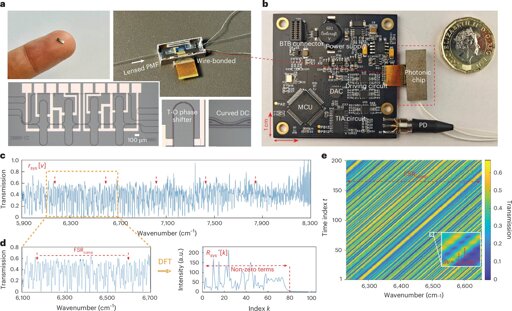
Researchers from the University of Cambridge and GlitterinTech, a startup founded by the same research group, have unveiled a fundamentally new type of optical spectrometer that delivers laboratory-grade precision in a device small enough to be embedded in portable and wearable technologies. By rethinking how spectra are measured and processed, the team has demonstrated a spectrometer costing only around $10, operating at a centimeter scale, and capable of applications ranging from industrial quality control to real-time health care monitoring.


This technology isn’t for generating images but for measuring what frequencies are present in light.
I’m not 100% sure on the specifics, but it sounds like they are using some mathematical properties of fourier transformations to either broaden the frequency response of sensors or simplify the math required to get the final result.
Hyperspectral cameras are designed to generate images from a matrix of light sensors.
This could maybe lead to spectral cameras (as in a camera where each pixel is the spectrum of light in that pixel), which could then generate images of arbitrary spectra, but I suspect that this sensor is still quite a bit larger than the sensors used in digital cameras these days. Even a hyperspectral camera doesn’t really care about what frequencies it measures, it’s just able to detect differences in amplitude at those frequencies and either doesn’t detect outside of that range or has something filtering the light outside of the range before it reaches the sensors.
From skimming, it sounds like they’re trying to use compressive sensing techniques, but push the “compute” to a physical, optical structure. That gives you a smaller device without the expensive compute (or the concern about losing data from random noise).
In general, it’s not hard to make a basic optical spectrometer. Most people have seen a prism splitting light into a rainbow. Imagine that plus an array of light sensing pixels. The light intensity on the array is your spectrum reading. The further away you put your pixel array, the more spread apart the colors in your rainbow, but the less light hits each individual pixel.
Optical spectrometers generally use diffraction gratings instead of prisms, but the trade-offs are the same. Longer optical path -> more spectral resolution -> more expensive light sensors.
Compressive sensing tries to break that trade-off by using math from information theory to get a usable data from fewer measurements. The single pixel camera is a great intro to the field. You use a single photodiode plus a series of known masks to take a series of measurements. From the masks + single pixel measurements, you can reconstruct the original image. There’s probably code out there to do it virtually if anyone’s interested. IIRC, to do a virtual measurement, you apply the mask to your image, then sum up the values. The reconstruction process is then identical to if you had real measurements.
For the $10 spectrometer, it sounds like they’re pushing some of that “compute” to a tunable optical system. In other words, the device “takes compressive sensing measurements,” but it does some of the reconstruction before it hits the light sensor.